Krietler famous for butter smooth metal training rollers recently introduced an add on magnetic resistance unit as a new step in the world of indoor training. Indoor rollers are amazing for realistic, ride feel, the ability to work on your balance and handling skills while training indoors.

Rollers essentially simulate a flat surface with a given rolling resistance, the resistance in general terms is very similar riding a smooth flat road, and while this realistic feel is great what they are not so good at is simulating climbs or higher power efforts – The resistance of the units is dependent on a few factors, the roller diameter (small= more resiatnce), tire size (larger = more resistance), tyre pressure (lower = more resistance), rider weight and your gearing ratio but even with all these factors you’re hard pressed to get over a medium level of resistance (thats 220watts worth of resistance for me personally). Can the Killawatt alleviate these problems with indoor training rollers?
The Killawatt is a $159 magnetic based resistance add on for 2.5″, 3″ and 4.5″ Krietler rollers. Base Krietler rollers are $599 -$649 dependent on size. If you are interested in other training articles, programs like Zwift etc ( training articles)
Product Details
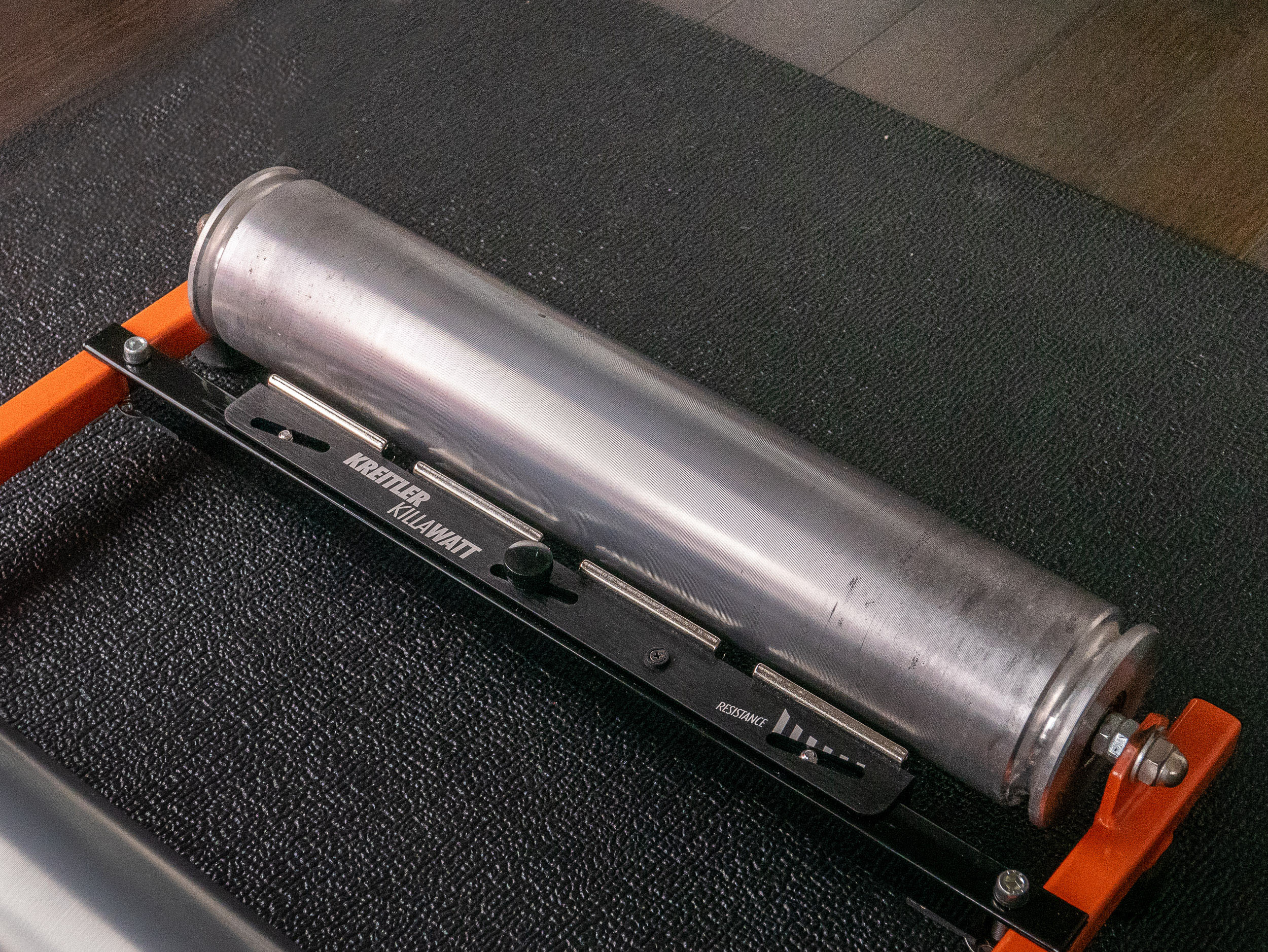
The Killawatt is refreshingly simple in execution, a powder coated metal bar that is attached across the rollers frame by a clamp either side using a 6mm bolt (5mm hex key) to move a little nut and disc as a clamp. This bar supports a sliding alumnium plate with four permanent 3300 Gauss Magnets.
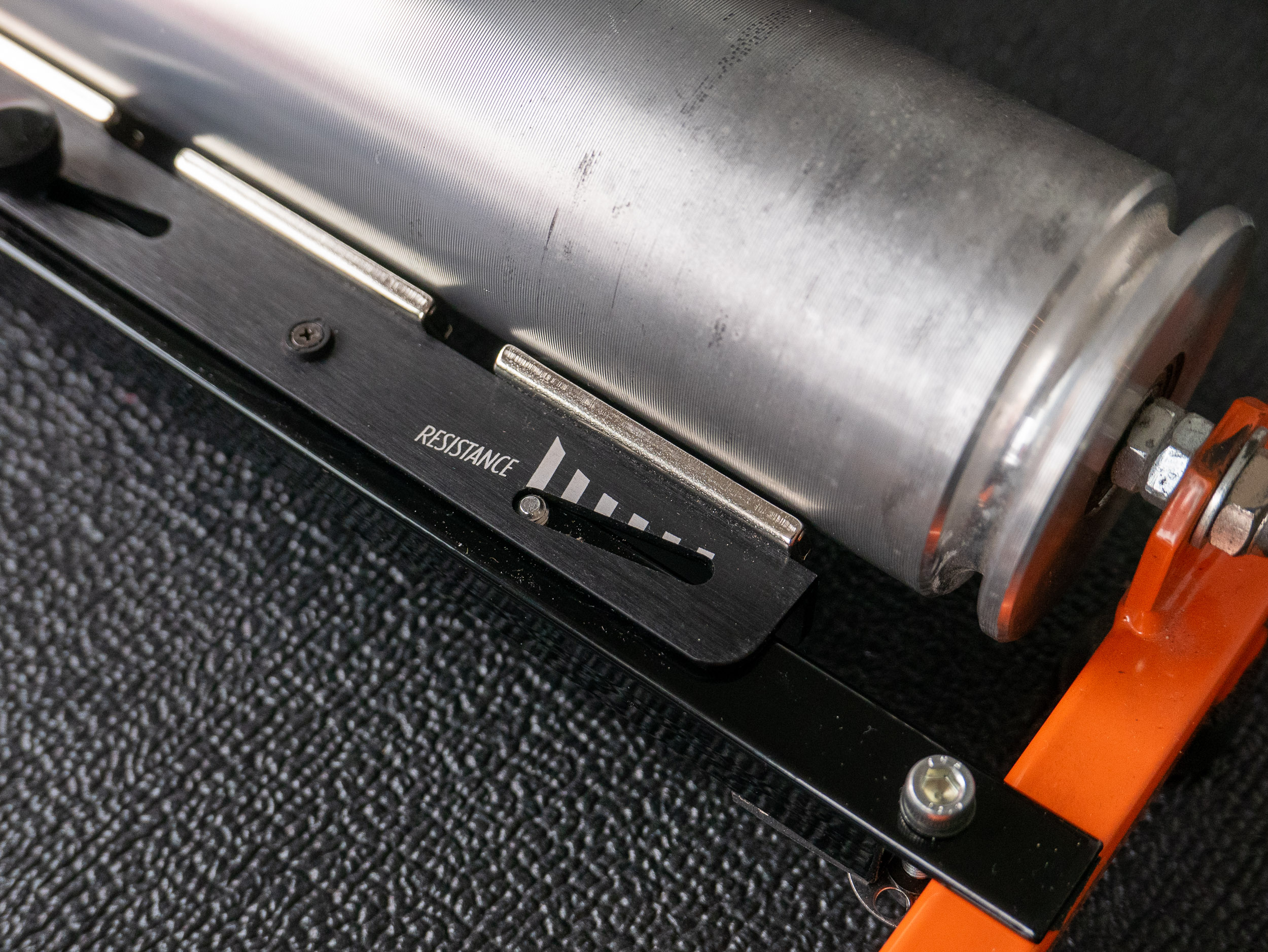
For adjusting the resistance setting, the magnets are moved further away and closer to the roller, by a convenient parallel sliding mechanism, simply unlocking a knob and pushing the slide left or right, On the slide there are 6 markings to indicate resistance levels (not detents). The highest resistance is when the magnets are closest to the roller drum. (In my later tests I use those marking to collect power numbers). The device is wellmade, high quality parts.
That’s it, simple!


Packaging & Setup
As you know by now, the packaging is always of interest to me, with an environmental bent I’m happy to say the Krietler packaging is industrial and minimal. No glossy flash flash., laminates or fancy, it’s basics here. The unit was shipped in a simple, small box, 2x2x17″ which refreshingly has no inner container, and simply with two pieces of foam padding on the ends of the metal product and one sheet copier style instructions. This I can get behind, minimal, functional, reasonable and environmental. – thank you!
The setup process is quick and easy. A spacing procedure to ensure magnet distance from rollers and two bolts attach the unit to the frame, theres not much to get wrong and the printed one sheeter is nice and clear.
Trainers, Magnets, Rollers?
Magnets are no big news in the world of trainers (turbos), used in different ways to create resistance for indoor cycling, static magnets are used in older stand based mag training products and electro magnets, today in Wahoo Kicker like products. What is beautiful in this instance of Killawatt is the simplicity and effectiveness of a well applied static magnet to increase resistance. Now we have to touch on a few things, first maximum resistance on rollers is depending on a few variables, size, gearing, weight of rider, size of tyres, pressure in tyres…. basically rollers top out at a certain level of resistance. For me a standard pair of rollers tops pretty early, but imagine going up hills, generating in excess of 400W is doable, then sprints of, 800watts. For this, normal rollers cannot handle. There have been a few solutions to increase resistance, add ons like belt driven fans which use air to add resistance, the execution of which is a bit clunky, with extra belts and bolts.
Aluminium is not magnetic, so how does all this even work?
Theres a whole load of info in physics regarding magnets, induction and gauss fields and it turns out we can make Aluminium work with magnets (in a special way) The basic principles say that when moving against or through magnetic fields it takes energy /effort /work to move through or away, this is the basis for creating the extra resistance you feel using a Killawatt. Rotating the roller drum though a close magnetic field, the stronger the field the more effort it takes to move through. When you induce more field / move those magnets closer to the drum then the more energy or watts you will need.
Deeper, for you nerds, the first thing to know is that the Krietler rollers are Aluminium, which is not what we know as typical magnetic material like iron, steel etc (Ferromagnetism). Aluminium is often thought of as none magnetic, which is kinda true, but Aluminium is a paramagnetic material meaning a magnetic field is not normally or permanently there but can be created (induced) within the aluminium metal structure , and is directly attracted to external magnetic fields. Inducing these magnetic fields is done by exposure to external alternating magnetic fields.. Bingo, and there we have it, lets put that together … high power external static magnets and a rotating aluminium drum nearby, essentially the alternation is via the rotation and the aluminium material moving while the external magnet gauss is static. Thus, when the internal field is formed ,the Alumnium roller drum becomes attracted to the external magnets. Thus a force is created that resists rotation. The force can be simply thought of as the resistance to turning the drum, boom RESISTANCE in Electromagnetism rules this is expressed as Torque … in what’s called the Magnetic Dipole Moment
In use – How effective is the Killawatt?
Bolting on the unit takes less than five mins and immediately you can feel it working. But, how much or even how usable is that resistance… for that I had to do some bench-marking and some measuring. I used Pedals that measure power, sensors for speed and rotation of cranks and a head unit set up to capture the data. After a couple of hours of capturing data and a few hours of just riding, it started to make sense,
I captured data on 3 levels of experiment. I wanted to see the affect of wheels speed and resistance on the system and I also wanted to see where the system would top out in terms of power. From my tests I did multiple runs of:
52x19t at 80rpms crank
52x16t at 80rpms crank
52x 11 at 100rpms crank
All tests conducted same within 2hrs, same bike, same rider. 28c supple tires with tubes and 80PSI. (more details are after the graphs)
The Killawatt can offer a large range of resistance
The Killawatt offers a large range of resistance, when compared to standard rollers. In practice this means it can accomodate many levels of riders and also offer a product thatcan grow with your fitness and preference. Generally speaking this simple add on can double the capacity of your rollers. From my test I found:
17.4mph rider can see increased resistance from 106% – 230%.
20.5mph you can expect to see an increased resistance from 130% – 280%
27mph on setting 6 a rider can see increased resistance up to 520% (Sprint level power)

The faster the rotational speed the greater the power required.
The key thing is note here is faster speed = more power needed, but also bear in mind at a low Killawatt resistance setting, this could exceed 100rpm, meaning you may have problems staying on the rollers. With the magnetic system as the drum turns faster the magnetic fields are stronger and the rider needs more power to turn the cranks. As you can see from the graph with the vertical shift in curves the power required to pedal on the Red line 20.5mph (33km/h) is 20-30% more than the Blue 17.4mph (28km/h)
The Yellow data points represent high wheel speed around 31-37mph (50-60km/h) at 100RPM, which is difficult to maintain on any setting above 2 or 3 due to the high resistance and nature and motion of rollers .
The Killawatt is suitable for training.
Even for the fit athlete with high demands.the Killawatt can deliver quite high wattage numbers that are normally associated with training (graph below), For perspective a typically super fit competitive amateur road racer could use Killawatt on setting 5 or 6 and get high resistance good workouts with wattages required between 300-400watts for example. Most racing athletes nowadays have powermeters, so the efforst required are instantly measurable my power pedals or power cranks /arms.
What about above 400watts? The Yellow data points represent high speed with a high resistance setting , around 31-37mph (50-60km/h) are not time sustainable at this setting due to the high power needed and iritic nature of generating that high power, this is differet froma. fixed base trainer which thoeretically you could ride 700watts for an hour. I amanaged to eek out 700watts for 10 seconds but that was close to my limits of output and balance. I wanted to test the power limit, and an understanding that these rollers could be used for a short 700W sprint is good info.

Testing Controls
All the data was all collected within a 1.5hr period on the same day, at the same room temperature, using the same bike, same rider, same setup. Krietler 2.5″ rollers. SRM X Power pedals which captures wattage, cadence, power balance and smoothness L/R balance. Data captured with a Wahoo Roam 2 unit. Additional speed data was collected with a Magene sensor on the front hub. 165lb rider on an 18lb bike, 700c wheels, inner tubes with supple Vittoria 28c tires at 80PSI
Topline: Krietler Killawatt
FORM = 9/10 (its great for what it is)
FEATURES = 5 / 10*
FUNCTIONALITY = 9.5 / 10
A BUY? = Definite YES
Theres not a lot to knock about this product, there’s only one issue from a Performance Riders perspective – say you are doing some training, a VO2 session, switching between short burst high power and low power resistance can be difficult. Iit means getting off the bike and changing the Killawatt’s setting. Which of course is pretty inconvenient. Given that this is a probably pretty rare occurrence is why I gave this a 9.5/10 and not a 10/10 – But to be fair for the most part a fit strong rider could use setting #4 and not have to change it. The issue is more when you fluctuate between extremes of low and high power.
Controllable trainers! – * if you look at this product through the lens of replacing or comparing to a controllable trainer the feature rating would be mid to low. Naturally a controllable trainer has a lot of features. If you look through the lens of gaining extra utility through rollers, the feature score would be High.
Existing Roller peeps
If you are a already a roller user, there’s only benefits here. The same butter smooth feel, Easy to install, effective, adjustable – you keep all the benefits of “rollers” and increase the resistance .Bottom line is $159 an easy, low fuss fitness add on.
Performance Rider
If you are new & interested into using rollers but concerned about how technically effective they will be for a training based workout, theres no need to worry, because from a capability standpoint this add on will provide more resistance than you need allowing you to use it as a training tool. The main consideration here is your overall experience and which training tools had you planned to use.
Fitness rider
If you are new & interested in using rollers for fitness, you will be pleased to know that the Killawatt bolt on feels like a great upgrade. Of course you can use rollers without Killawatt, but should you develop the need extra resistance, now there is an easy expansion path.
Post experiment – A few things to note:
Using resistance setting 6 (the strongest stetting) created more heat and heated up the Aluminium roller notably quicker than 1-4. the affect of this heat will affect the magnetic field and reduce its efficay. ( a reduced magnetic flux field), showing a non proportional increase in resistance. This is really only of concern at power numbers above 350Watts.
Theres a small fluctuation in data between setting #2 and #3, I don’t have an explanation for this. Did it affect our overall test. Not really.
Of course, tell me if you like this review or not…. would love to hear in the comments. – jbucky
Discover more from Buckyrides
Subscribe to get the latest posts sent to your email.
 Buckyrides